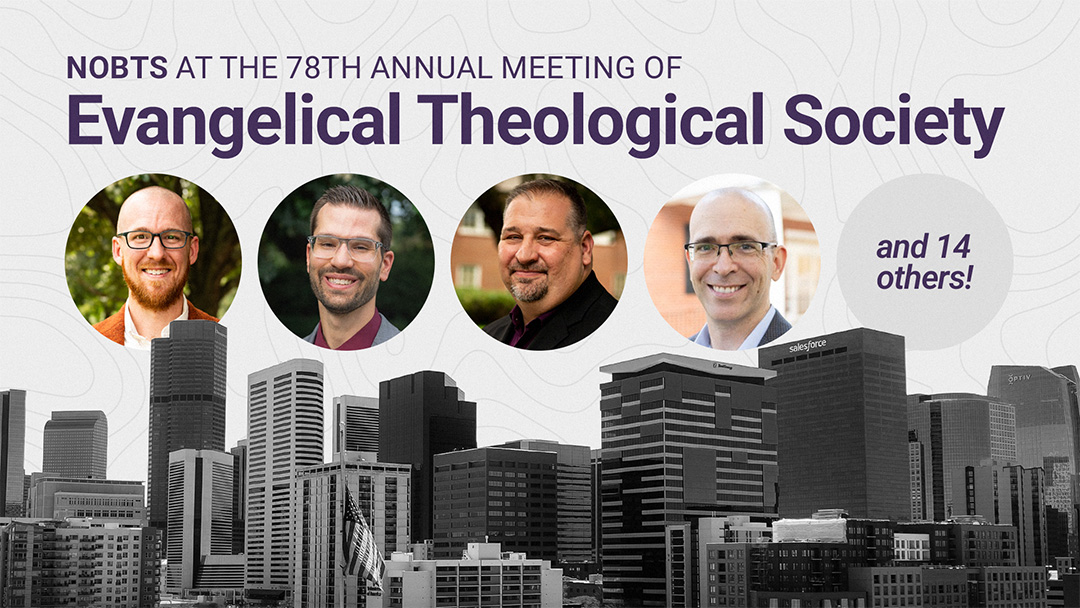
Several NOBTS faculty members and students presented research papers during the 78th annual meeting of the Evangelical Theological Society (ETS) Nov. 17-19.
This year's ETS meeting (taking place in Denver, Colorado) operated under the theme of "Defending the Faith," and 18 NOBTS faculty members and students presented academic papers in the areas of Old Testament, New Testament, philosophy, anthropology and more.
Even more faculty members and students moderated discussions at the conference and several seminary alumni also presented papers.
ETS is a well-known professiosnal academic society that requires particular confessional positions for its membership such as Trinitarian theology and the authority and inerrancy of Scripture.
Their annual meeting provides the opportunity for dozens of academic scholars to present research and fellowship with one another.
Cory Barnes is associate professor of Old Testament and Hebrew and dean of graduate studies at NOBTS. He said ETS is an incredibly important opportunity for seminary faculty for several reasons.
"Participation in ETS is important so that our faculty can shape the discussions of what's happening within Evangelical higher education and Evangelical scholarship, and also, when appropriate, to be shaped by the conversations that are happening within Evangelicalism," Barnes said.
"ETS provides faculty the opportunity to participate in theological discussions where their filter is going to be much finer than in other contexts, because of the shared Evangelical beliefs.
"Our faculty are dialoging in spaces outside Evangelicalism, but ETS is one of the most important spaces our faculty is dialoging because this is a context where fellow Evangelical theologians talk about how they are understanding the Bible, theology and their practical application to ministry."
Terry Iles, director of the NOBTS Ph.D program and associate dean of research doctoral programs, said he is deeply grateful NOBTS faculty are able to attend ETS.
"I deeply appreciate that these things are a priority for the seminary," Iles said. "I believe as faculty it keeps us fresh and keeps us accountable for producing research.
"For both our faculty and students, it's a great opportunity to share research and meet scholars at other institutions.
"I think it's also valuable for the churches that we serve because this is a context where very important theological ideas are being talked about. I'm grateful that we get to be a part of those conversations and we get to influence them. These are conversations that absolutely will impact the church down the line."
Most of the NOBTS students presenting at ETS are doctoral students, and Iles described getting to see them present their research as "exhilarating."
"It's really exciting to see students present their papers and grow as scholars. I also enjoy the opportunity to fellowship even more with students," Iles said. "This is a fantastic way to love God with all of our mind and love our neighbor with our scholarship."
Eric Duenke serves as Ph.D coordinator for NOBTS and is working on a Ph.D in biblical exposition.
"As a Ph.D student these events are incredibly important because we are scholars in training and this is sort of like on-the-job training for us as we present research and interact with fellow academics," he said.
Barnes said a phrase faculty often use when explaining the goal of doctoral studies is to help "cultivate a colleague," and events like ETS serve as a marker of success for this goal.
"The goal is that we are not training someone who is constantly going to be at the other end of the classroom from us, but we actually are training someone that would eventually become colleagues," Barnes said. "The end result is that these students could serve as professors in higher education.
"So when I see some of our doctoral students presenting at ETS, that's a significant milestone for me to see that this person is really moving towards becoming a colleague of mine because they are doing what colleagues do by presenting research. I'm benefiting from their scholarship myself by hearing them present their paper.
"It makes me proud of our school and what we're able to accomplish here. Anyone wondering about the quality of our doctoral programs can simply check the listing of presenters we have at ETS. We have students that are in these rooms as experts and are being heard by notable scholars. Our doctoral students are also shaping and being shaped by this ETS participation."
Iles said helping doctoral students participate in academic research is another way to carry out the mission of the seminary.
"Our mission statement is that we exist to prepare servants, and that includes our Ph.D program," Iles said. "Our Ph.D students are being prepared to serve a number of different communities. They are becoming servant scholars who serve the Church, and they are also becoming members of the academic community. They are learning to be a neighbor and a servant in that academic community. Being a part of academic conferences like ETS is a big way that we serve that academic community."
Barnes echoed this sentiment about the importance of seminary's connection to the academy, framing it as one way that NOBTS ultimately trains servants for the Church.
"Our connection to the academy is important because it sharpens our ability to fulfill our mission, especially in the local church," Barnes said.
"I do not see the connection as being there is the academy and then there is the Church and the seminary is in the middle of those with an equal obligation to both constituencies. As the seminary, our mission in centered on the Church and the Kingdom of God, and our involvement in the academy is one of the ways that we make sure that we fulfill that mission to the Church and the Kingdom well.
"The academy helps us not grow stale in the way we're reading and applying the text. The academy is also allowing us to have broad collaboration about how we are fulfilling our mission, and ETS is valuable specifically because we are beside like-minded people in the academy."
Barnes continued to say that President Dew himself encourages faculty to do quality academic research.
"Dr. Dew has a particular effort and a particular vision for the role of faculty research and publication," Barnes said. "He understands that our faculty being active in research and publication, through ETS and other venues, is allowing our faculty to love the Lord with their minds and equip others to do the same. This something that he really pushes us as faculty to do, and we have been able to publish more in the last few years than we had previously."
When bringing in new faculty, NOBTS administration has prioritized not only academic success but also practical ministry experience.
"We have tended to hire people in appropriate disciplines that have a strong record of publication and have dialogued well in the academy, but that doesn't mean we have hired a lot of ivory tower theologians that maybe can talk in the ETS world but are not going to be able to talk in the local church," Barnes said.
"What we have is a group of people that are very involved in the academy and very accomplished in their research but are also standing behind pulpits in Southern Baptist churches and helping local congregations walk through practical aspects of applying Scripture and theology on a weekly basis.
"I'm proud and thankful for what the school has seen in President Dew's administration of bringing in excellent scholars, but I am even more proud and thankful that we have not lost a step in bringing in people who are practitioners in the local church. We are a faculty of academics who are practitioners."